THE LIFE AND TIMES OF NICK CROWSON
Welcome to the reviews and articles of N J CROWSON

Selected Favourite Paintings Gallery and Commentary
Article, 2016
This eclectic section of favourite paintings reflects the creative art form much practiced by myself. You will notice the selections are drawn from a narrow time frame in the history of painting.
This is a personal compliment to the group of impressionist painters, based in Paris, towards the end of the nineteenth century. These paintings are predominately of impression or a post-impressionistic style. By this time the understanding of perspective was well practiced and now images represented the everyday world and situations of mankind, rather than religious iconography or the depiction of stately royals.
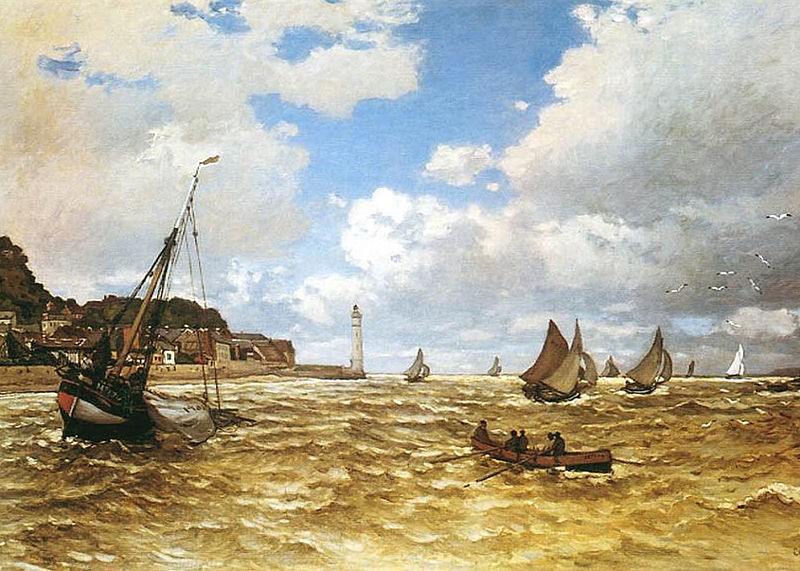
1. The Seine at Honfleur by Claude Monet.
Oil on canvas (89.5 x 150.5cm) The Norton Simon Foundation, Pasadena, Caifornia.
Claude Monet 14 November 1840 - 5 December 1926
This painting was observed from a jete overlooking the harbour at Honfleur, in 1865. Monet was 24. He gives the name "impressionism' from the title of an exhibition piece in 1874, entitled 'Impression, Sunrise' and was one of the most prolific and consistent painters of this school. He is a great documenter of the French countryside, painting similar scenes at different times and seasons, emphasising the effect light has on the perception of his paintings.
To view more of the Norton Simon Foundation collections, which includes European art from the 14th century to the modern day, click on the following link.
Norton Simon Foundation Colletions
Click on the image itself to view in splendid isolation.
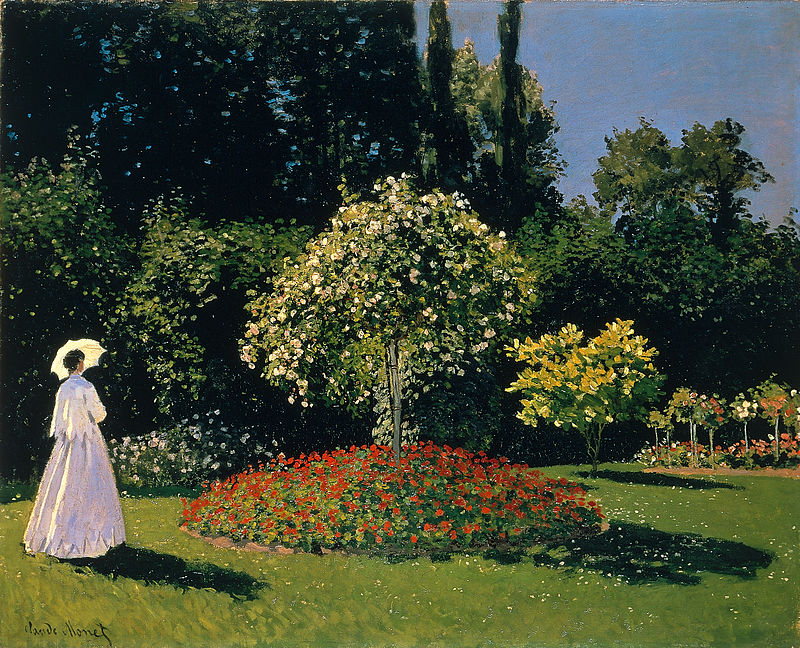
2. Woman in the Garden at Sainte-Adresse by Claude Monet.
Oil on canvas (82 x 101cm) The Hermitage Museum, St. Petersburg.
Claude Monet, 1867.
Monet's second painting here depicts a woman in the garden at Sainte-Adresse, near Le Havre. This setting was an estate owned by his cousin Paul-Eugene Lecadre and it's his wife dressed in the fashionable style of the time. The garden was to become his predominant bearing in later life, where he cultivated the garden at Giverney.
This painting is housed at the State Hermitage Museum, St. Petersburg. To see more of their material (there are over 1 million pieces of art) click the link below.
The State Hermitage Museum Collection
3. Garden by the Sea at Honfleur by Claude Monet
Oil on canvas, 1867 (98.1 cm x 129.9 cm) The Metropolitan Museum of Art, New York.
This is one of many works created around Honfleur, at this stage in his career. Monet was 27.
The painting works on many levels for me. The land/seascape offers a great range of subject matter. Weather, sky, sea and land come together mixed with the stylish dress of the day and the arrangement of flora in the frontispiece garden. The mid-ground flags present angularity, which diverts the eye, helping to suggest the windy conditions and contrast well with the more rounded shapes of the umbrellas and the slightly irregular but rather concentric arrangement of the seating. Best of all, adding tone and atmosphere is the effect of lighting and the very persuasive shadowy outlines of people, planting and seating. Monet's piece also works wonderfully in the perspective it offers from the larger figures initially seated to the more distant mid-ground figures. He repeats the effect with the mid-ground sailing vessel, contrasted with the more miniature horizon set boating. To me this is the highpoint in artistic expression through the ages. Though I appreciate the Old Masters ability to represent lavish customary, in style and substance and facial toning in more close up detail are not obvious here.
This painting is held at the Metropolitan Museum of Art, known colloquially as 'the Met'. Here you will find works by most of the European masters, besides collections from antiquity, Asia, Africa and, of course, America. Click on the highlighted link below to access this collection.

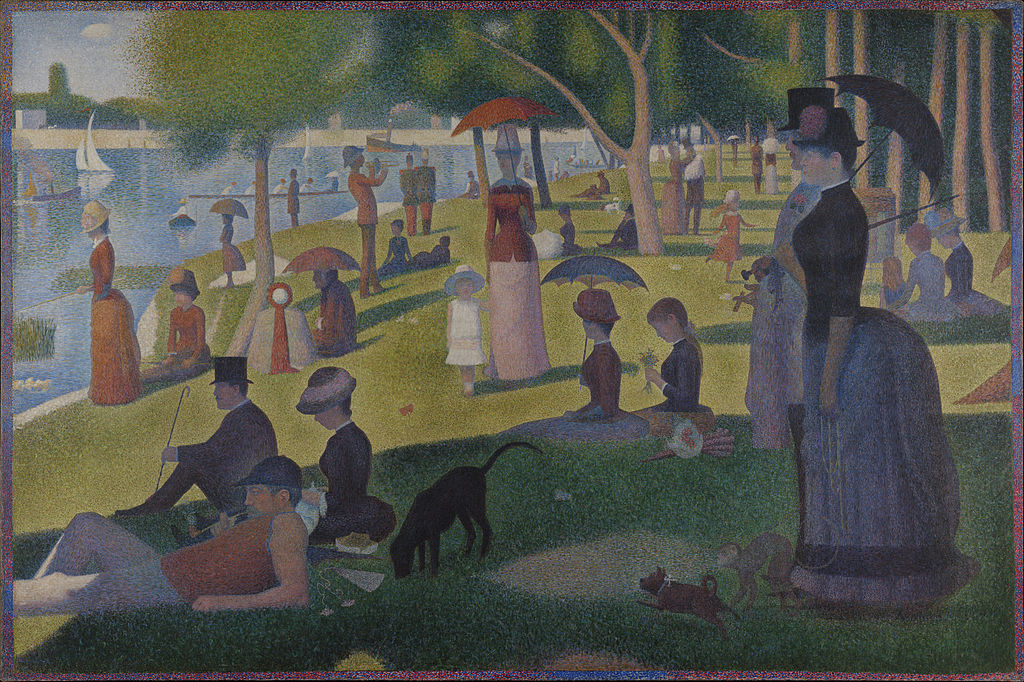
4. Sunday at la Grande Jatte, Paris by Georges Seurat
Oil on canvas (207.6 X 308 cm) Art Institute of Chicago.
Georges-Pierre Seurat 2 Dec 1959 - 29 Mar 1891. This painting was undertaken between 1884 - 1886 and was the result of a lengthy undertaking, in regular sketching visits to this part of Paris. Seurat is the figure arguably most associated with the pointillist style of painting. That is the use of dots and marks to convey light and colour. This particular painting was exhibited at the last Paris exhibition by the main group of impressionists. He is classed as a postimpressionist, who attempted to present impressionist concepts of light and colour in a new way. This style has the effect of 'stilling' the scene, rather than conveying any movement and dynamic of a work. Indeed the technique is one mastered by Seurat, with his skill and draughtsman's training, but has often produced works which appear stilted, incomplete or messy. Indeed, these were some of the criticisms issued at this paintings first exhibition. Seurat is seen as a developmental figure in the work of Vincent Van Gogh and more particularly in pointillist terms, Paul Signac. To view more of the online collection at the Art Institure of Chicago, which include European paintings and sculpture, contemporary work and ancient and American collections, click the link below. Art Institute of Chicago Online Collections 5. The Fighting Temeraire by J M W Turner Oil on canvas (91 cm x 122 cm) National Gallery, London. Joseph Mallord William Turner (circa) 23 Apr 1775 - 19 Dec 1851. This painting was undertaken in 1838, when at the peak of his powers. It features HMS Temeraire being towed to its final resting place to be broken down for scrap. This greyish, shadowy, ghostly shape, pulled by the tug represents the ship which saw distinguished service at the battle of Trafalgar in 1805. It displays Turner's mastery of the weather conditions, sea and the effect of light. To my mind he encapsulates the reality of an historical setting with the impression of the subject and scene setting. Click on the link below to see this painting and other collections at the National Gallery. Here you will find 2,300 European paintings from as early as the 13th century up to the early 20th century. The National Gallery Collections